
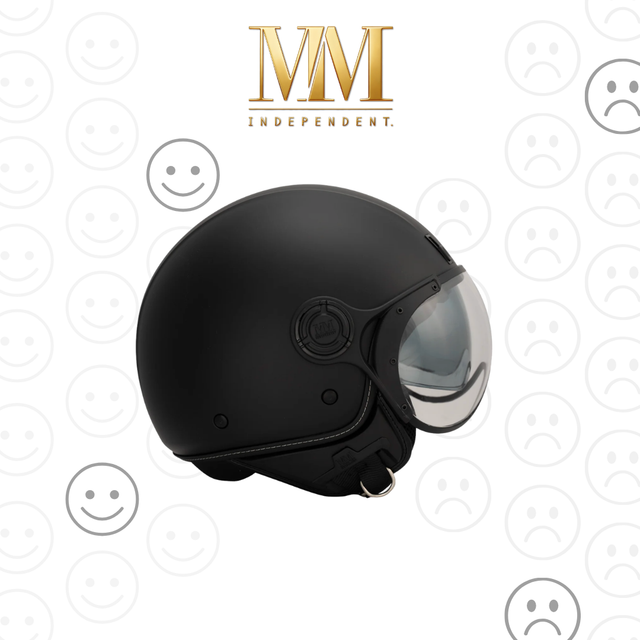
Matte black: pros and cons of an increasingly popular finish
There was a time when black was dismissed as the easy choice: safe, but predictable. That cliché is increasingly outdated, especially when it comes to a jet helmet.
Matte black works not simply because “it goes with everything”, but because it has presence and depth. It can be essential without feeling anonymous.
On a model such as the A‑Ventura Monocromo Black, the finish absorbs light, cleans up the visual line of the shell and draws attention to shape, proportions and details without shouting.
Why is matte black so popular on jet helmets?
A jet helmet relies heavily on silhouette. The cleaner the line, the more clearly its character emerges. Matte black does not reflect light like a gloss finish, so the eye stays focused on the shape.
This makes it especially convincing in the city, where the helmet is seen up close and becomes part of personal style. It feels contemporary not because it follows a trend, but because it balances aesthetics, identity and everyday use.
Does matte black really mean “boring black”?
No. Matte black often represents the opposite: a deliberate choice for people who do not need easy visual effects to make an impression.
On a jet helmet, it shifts attention from decoration to presence. It can be minimal without being poor, restrained without becoming impersonal. In a world of glossy surfaces and highly saturated colours, matte black offers a more mature kind of elegance.
What are the practical advantages of a matte-black finish?
First, the visual effect: matte black gives the shell a more tactile and contemporary appearance.
Second, everyday practicality: it can hide dust and very small imperfections better than glossy surfaces. That does not mean it stays clean, but it often tolerates routine use without immediately losing visual balance.
Third, versatility: a matte-black jet helmet works with many motorcycles, scooters, jackets and settings. It adapts without disappearing.
Are there disadvantages?
Yes, but they are mostly about care. Because matte black absorbs rather than reflects light, incorrect cleaning can leave visible marks or uneven areas.
Aggressive products, unsuitable cloths and dry rubbing are the real enemies. A matte finish treated correctly keeps its depth and uniformity; one treated like any generic surface can deteriorate visually.
How should a matte-black shell be cared for?
Avoid instinctive hard rubbing. First remove loose dust, then use a soft, slightly damp cloth with gentle passes and no aggressive cleaners.
If rain and dust have built up together, work gradually rather than trying to clean everything quickly.
For more detail, see the guide on how to clean and sanitise a jet helmet without damaging it.
The key point is simple: a matte finish should be preserved, not polished.
Why does matte black suit MM Independent design so well?
MM Independent works strongly with visual identity, whether through bold regional graphics or by stripping decoration back and letting the surface speak.
In the Monocromo line, the effect is especially clear. With little decoration beyond the reflective gold Chrometech® logo, the shell shape, urban character and precision of the design come to the fore.
This is why matte black is often perceived as a contemporary classic: stable but not static, essential but not cold.
Matte black in everyday use
A helmet is not experienced only in photographs. It is picked up, put down, worn for short journeys and exposed to dust, pollution and changing light.
Matte black remains convincing because it combines visual presence with ease of everyday use. It does not need to change personality with the context.
Is a matte-black jet helmet worth choosing?
If you want a finish that combines style, everyday practicality and a strong visual identity, yes—provided you understand how to care for it.
Matte black is not the loudest choice. It is a choice for people who appreciate well-made surfaces, clean lines and a presence that does not need to raise its voice.