
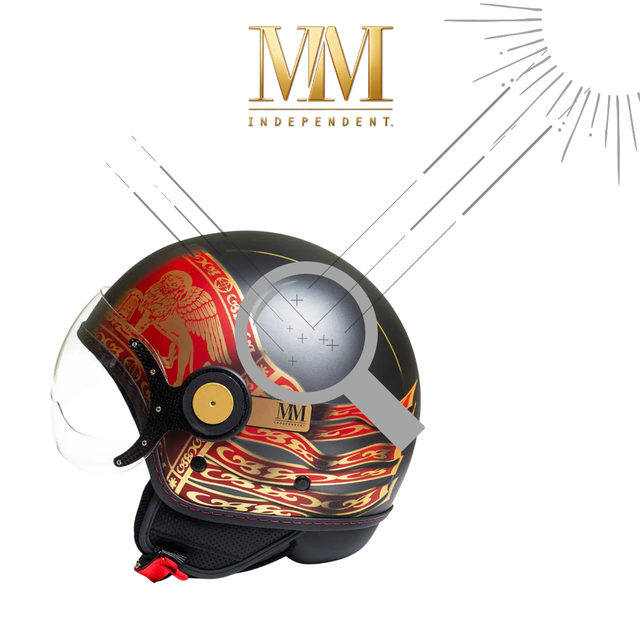
Sun on your helmet: how to prevent fading and premature ageing
A helmet does not age only through mileage. It also ages while you are not wearing it. Sunlight is one of the most underestimated factors: it rarely causes obvious damage overnight, but over time it can dull finishes, alter surfaces and change how the helmet looks and feels.
Talking about helmet care to reduce sun-related fading means talking about habits:
- where you leave the helmet after parking
- how you clean it in hot months
- how much direct light, heat and temperature change it experiences
MM Independent helmets use ABS shells and dedicated paints designed for greater resistance to weather exposure. Compatible MM visors also use scratch-resistant treatments and UV filtering.
Resistance, however, does not mean invulnerability. That is where intelligent maintenance matters.
Why can sunlight age a helmet prematurely?
UV radiation, accumulated heat and repeated exposure can gradually make surfaces duller, less uniform and more vulnerable to dust and marks.
In summer, the effect can accelerate if the helmet is left for long periods on a seat, hot top case, windscreen area or other exposed surface.
Heat does not affect only the shell. Visor, trim, finishes and interior materials also react to excessive temperatures, changing both appearance and the overall experience of use.
What does “weather resistance” really mean?
It means the helmet is designed for real daily use, using materials and finishes intended to cope with the road environment. It is a starting point, not a guarantee against every form of ageing.
A well-built helmet can resist time, sunlight and frequent use better, but poor habits can still accelerate deterioration. Product design does part of the work; the user’s routine completes it.
What are the most common mistakes in hot weather?
First: leaving the helmet in direct sun for convenience—on the seat, mirror, hot top case or rear shelf of a car.
Second: cleaning it carelessly just when heat, fine dust, sweat and atmospheric residue make surfaces more sensitive.
Third: assuming only bright colours suffer. Even restrained finishes such as matte black can show the effects of repeated exposure and incorrect care.
How do you protect a jet helmet from the sun in real life?
The most effective measure is also the simplest: avoid unnecessary prolonged exposure.
Whenever possible, keep the helmet in the shade, in a compartment or bag, and away from surfaces that accumulate heat. After long summer rides, let it breathe before closing it in a confined space so that internal heat and humidity can dissipate.
The same applies to visors and accessories: products can be engineered to tolerate outdoor conditions, but no surface benefits from being abandoned under intense sunlight.
Why cleaning and sun protection belong together
A surface exposed to strong light, dust and residue can become more sensitive. Cleaning it incorrectly can create permanent marks on finishes or visor surfaces.
In hot months, maintenance should therefore be more careful, not more aggressive: remove loose dust first, then use a soft, slightly damp cloth without force or haste.
The visor needs particular care because dried residue and accumulated dirt increase the risk of micro-marks and reduced clarity.
For a complete method, read how to clean and sanitise a jet helmet without damaging it.
Matte black, sunlight and stereotypes
A dark finish is not automatically “bad in the sun”. The issue is not colour alone but how the surface is treated over time.
A matte surface can show mistakes such as aggressive products, rushed cleaning or working on a hot sun-exposed shell. Correct maintenance helps it remain deep, even and contemporary after long use.
The answer is therefore not to avoid dark colours, but to care for the helmet properly.
Sun on your helmet, with common sense
Preventing fading and premature ageing does not mean worrying about every ray of sunlight. It means adopting habits consistent with the quality of a well-made urban helmet.
A good helmet is designed to accompany you every day. Avoid letting poor parking choices, accumulated heat or improvised cleaning make it age faster than necessary.
It is about attention, not obsession: you cannot avoid the sun completely, but you can avoid giving it unnecessary exposure.