
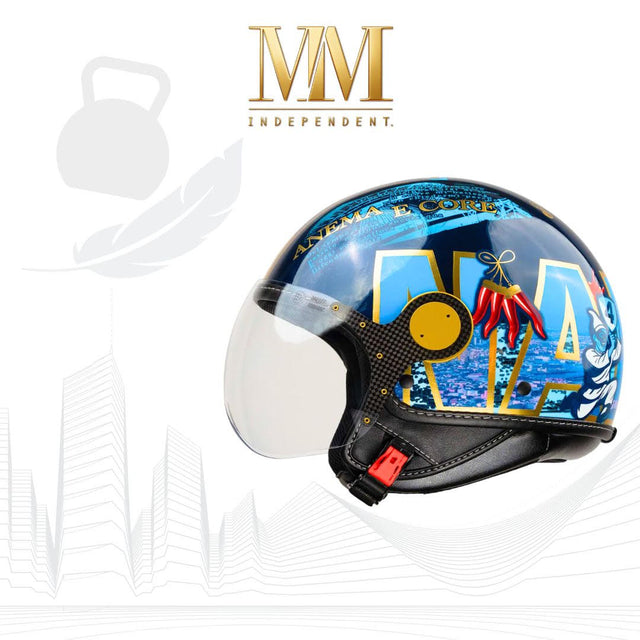
How much does a jet helmet weigh, and why use one in the city?
The question “how much does a jet helmet weigh?” sounds purely technical. In reality, it is about something much more practical: how the helmet feels every day.
In traffic, at lights, on short journeys and when putting the helmet on and taking it off several times, weight stops being a number and becomes a sensation.
This is where the jet helmet shows its urban character: broad field of view, ease of movement and practical everyday use compared with more enclosed formats.
Not all jet helmets weigh the same. Materials, size, visor, padding and components all influence the final figure. But one principle remains: a good urban helmet should protect without becoming cumbersome. You should notice its quality, not its fatigue.
How much does a jet helmet weigh in real life?
Weight varies according to structure, size and equipment.
MM Independent A‑Ventura models are indicated at roughly 1,100–1,200 grams, with variations depending on size and configuration.
The useful point is not simply the label “lightweight”, but the perceived weight in everyday use.
You notice the difference after half an hour in traffic: whether the neck remains relaxed, whether you can turn your head naturally and whether the helmet feels like an extension of movement rather than a block.
Why is weight not only about grams?
A helmet can be objectively light and still feel uncomfortable if it is poorly balanced, fits badly or creates pressure in the wrong places.
A well-engineered helmet can feel lighter than its specifications suggest because weight is distributed more evenly and the helmet follows head movement correctly.
Measured weight and perceived weight are not always the same. One is read in grams; the other is felt on the body.
In the city, with constant small movements, stops, starts and changes of direction, perceived weight becomes especially important.
City traffic, lights and stop-and-go: where a jet helmet makes a difference
Urban riding involves traffic lights, pedestrians, parking manoeuvres, roundabouts and narrow spaces. The helmet should allow natural movement and maintain good awareness of the surroundings.
A jet helmet responds well to that use case: wide field of view, easy handling and a more open feeling. For daily use, this practicality can matter as much as the number on the scale.
Is a lighter helmet always better?
No. Lightness is valuable only within a coherent overall design.
A helmet that cuts too much from structure, stability or comfort does not become better simply because it weighs less. The goal is balance: light enough not to fatigue, structured enough to feel stable and reassuring.
Materials, padding, visor, retention system and shell shape all contribute. Weight should never be judged in isolation.
Weight, size and comfort: three factors to read together
Helmet weight affects comfort, but size matters just as much.
A helmet in the wrong size can make even a low weight feel unpleasant. Too tight and pressure becomes the problem; too loose and movement creates instability.
Before asking only how much a jet helmet weighs, ask how well it fits and whether the size is correct.
Why use a jet helmet in the city?
Because city riding rewards practicality. A jet helmet is quick to put on, suits short daily journeys and supports natural head movement.
The advantage is not only physical. A helmet that does not feel unnecessarily heavy, isolating or awkward can make it easier to stay focused on traffic, lines, spaces and people.
It is not a universal solution for every riding context, but in its natural environment—the city—it can offer a very coherent balance of protection, comfort and freedom.
Urban style: when lightness and personality work together
A jet helmet remains visually close to the face, shapes the silhouette and interacts with motorcycle, scooter, jacket and posture.
Practicality does not have to erase personality. A helmet can be comfortable and recognisable at the same time. This is one of the directions behind MM Independent’s approach: combining real-world use with a strong visual language.
How much does a jet helmet weigh? The right choice is felt, not just measured
Knowing the number is useful, but not sufficient. Weight should be read together with fit, balance, materials, intended use and real riding sensation.
In the city, a comfortable, stable and well-proportioned helmet makes every journey smoother. It does not demand attention; it simply does its job.
That is one reason the jet helmet continues to make sense in urban mobility: when it is well designed, it does not weigh on your day—it accompanies it.