
Night visibility on a scooter: why your helmet should be seen, not just noticed
By day, a helmet can stand out through colour, graphics, finish or the way it matches the motorcycle. But what changes at night?
For night visibility on a scooter, headlights, street lighting, background contrast, road position and everything that makes the rider easier to recognise all matter.
The helmet is one of the highest elements in the rider’s silhouette. Colour and retroreflective details can therefore contribute to recognisability when struck by a light source.
But one rule remains essential: no helmet replaces effective vehicle lights, suitable clothing, attention and correct road positioning.
Why is it harder to be recognised at night?
At night it is not enough to see the road—you also need to be interpreted quickly by drivers approaching from the front, rear or side.
Streetlights, headlights, shadow and wet asphalt constantly change contrast. At intersections, roundabouts, lane changes and turns, the silhouette of scooter and rider can blend into the surroundings more easily.
Night visibility on a scooter is therefore the result of several coherent signals, not one miracle element.
Does helmet colour really matter when light drops?
Yes, but with nuance. A light or bright colour can be perceived more quickly in some conditions; a dark helmet does not automatically become invisible.
Contrast, movement, ambient light and reflective or retroreflective details also matter.
This is the same principle discussed in our article on how light, dark colours and finishes change helmet perception across seasons.
Colour is one part of visibility, not visibility itself.
Chrometech®: when an aesthetic detail reacts to light
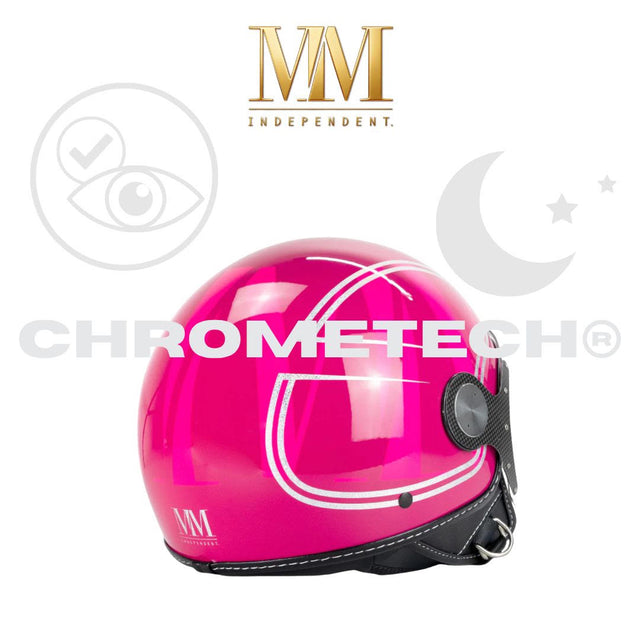
Many MM Independent collections use Chrometech®, a retroreflective colouring technology that makes lettering, symbols and finishes stand out more when hit by artificial light such as vehicle headlights.
By day, the detail contributes to graphic identity. At night, it can respond differently by reflecting received light.
This does not turn the helmet into a light-emitting device or guarantee safety on its own. It adds recognisability where an aesthetic detail already exists.
It is consistent with the MM Independent approach to colour, technique and Made in Italy as parts of one design project.
Visor and field of view: at night transparency becomes essential
Being visible to others is not enough if the rider cannot see clearly.
At night, a clean visor without significant scratches and appropriate for the lighting conditions helps maintain a clear view. Haze, scratches and damaged surfaces become much more distracting under headlights and streetlights.
Tinted visors require particular care. Check their approval and especially any “Daytime use only” marking. A visor carrying that indication is not suitable for night riding or poor-visibility conditions.
At night, appearance cannot take priority over the quality of vision.
Jet helmet and city riding: visibility should be considered together with use
The jet helmet is often chosen for urban mobility because of its open configuration and practical use.
Because it is frequently used in traffic and at intersections, rider recognisability deserves attention.
Before colour, first consider whether a jet helmet is consistent with your city use, journey length and season. No finish can compensate for choosing the wrong helmet type for the real route.
How to improve night visibility without overcomplicating things
- Check scooter lights: they should work correctly and stay clean.
- Keep the visor clean: haze and scratches increase reflections and glare.
- Consider colour and retroreflective details: especially if you ride frequently after dark.
- Use high-visibility elements when the context requires it: the helmet is only one part of your silhouette.
- Avoid blind spots: being visible also means choosing a road position other drivers can read.
Recognisability comes from the combination of helmet, vehicle, clothing and behaviour.
Being seen without giving up your style
There is a difference between a helmet that attracts attention and one that remains visible. The first catches the eye through strong graphics; the second preserves its identity even when lighting becomes more difficult.
For MM Independent, the two can coexist. Chrometech® details, brighter finishes or well-designed graphics can help a helmet stand out without making it alien to the rider’s style.
Night scooter visibility: when design and attention work together
Night visibility is not simply the result of choosing a bright helmet. It comes from choices that work together: lighting, visor, helmet surface, clothing, road position and attention.
The helmet can contribute because it occupies a highly visible position on the rider.
When it can be seen without ceasing to represent you, function and style become part of the same conversation.