
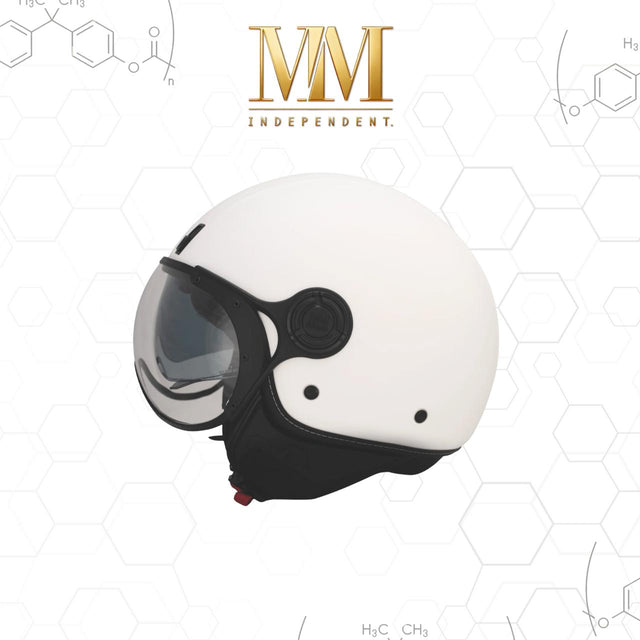
Jet helmet materials: ABS, polycarbonate and fibre
When discussing jet helmet materials, it is easy either to oversimplify or to get lost in technical language that means little to someone who wears a helmet every day.
In reality, the shell material is not part of a ranking for the “most advanced” option. It is an engineering choice that affects how the helmet behaves in real life, especially in the city, where mobility means short journeys, traffic and frequent use.
Understanding the real differences between ABS, polycarbonate and fibre means starting from use rather than labels.
Why jet helmet material matters in urban use
In a jet helmet, the shell material influences concrete aspects such as stability, durability, perceived comfort and cost.
It is not simply a question of impact resistance, but of the overall balance of the product.
In the city, a helmet may be put on and taken off several times a day and used in changing conditions. The material therefore needs to remain reliable without making the riding experience unnecessarily heavy or awkward.
This is also where misconceptions can arise.
ABS jet helmets for city riding
ABS (Acrylonitrile Butadiene Styrene) is one of the most widely used materials in good-quality jet helmets.
It is sometimes seen as a compromise, but in reality it is a deliberate technical choice, particularly for urban use.
ABS is a high-performance thermoplastic that allows precise shell engineering, with good energy-absorption characteristics and reliable durability.
With urban jet helmets, there is no single material that is right for everyone. The correct choice is the material that fits the intended use and the overall helmet design.
For MM Independent, choosing ABS is not about following trends or chasing extremes. It supports the aim of creating a balanced, reliable jet helmet designed for everyday city use, prioritising functionality, comfort and durability while leaving room for a strong, recognisable design.
Polycarbonate: real differences and rider perception
Polycarbonate is another thermoplastic widely used in helmets.
It is sometimes described as an “evolution” of ABS, but in practice the differences depend heavily on the helmet’s overall engineering.
It is a strong thermoplastic used in many shells. In normal urban use, the difference between ABS and polycarbonate is not always obvious to the wearer, particularly when the helmet is well designed and correctly approved to current standards such as ECE 22.06.
In these cases, what matters most is the final result in terms of comfort and reliability, not the name of the material alone.
Fibre jet helmets: when they really come into play
Fibre-composite helmets belong to a different category.
They are often associated with multi-layer structures and more complex manufacturing processes, frequently with a focus on keeping weight down.
These solutions can be particularly well suited to long, continuous periods of use that are less fragmented than typical urban riding.
That does not automatically make fibre the best choice for a jet helmet designed primarily for the city.
As always, the answer depends on actual use, budget—fibre helmets generally sit at a higher price point—and the rider’s individual preferences.
Material and safety: what really makes the difference
One point should be clear: material alone does not define helmet safety.
Safety comes from the complete design, including:
- shell
- padding
- retention system
- approval and certification
A properly approved jet helmet has passed specific tests and must meet demanding European standards.
Material contributes to that result, but never works in isolation.
Material, comfort and design
In an urban jet helmet, shell material never works alone. It is the foundation on which fit, balance and visual identity are built.
This design coherence allows MM Independent to develop strong, recognisable graphics, often tied to places and local identities, without losing the balance needed for everyday use. Material is therefore part of a wider design project rather than just a technical specification.
Why urban mobility is about balance, not extremes
Urban mobility does not necessarily require extreme solutions. It requires coherence.
A jet helmet should work well every day and remain comfortable, stable and dependable. That is why materials such as ABS continue to be chosen deliberately: they answer a real practical requirement.
The better question is not “which material is best in absolute terms?”, but “which material best suits the way I ride?”
Jet helmet materials: choosing with awareness
Talking about jet helmet materials means looking beyond labels. ABS, polycarbonate and fibre do not form a simple hierarchy; they are different answers to different needs.
In an urban context, a well-designed, properly approved, good-quality helmet suited to everyday use offers what matters most: protection, comfort and long-term reliability.
That is the criterion that makes the difference—not on paper, but on the road.